Naukri Resdex Optimizer: how Indian recruiters actually find you
If you're job-hunting in India, Naukri is inescapable. It's home to 9 crore+ profiles and the primary sourcing tool for 90% of Indian recruiters. And here's the uncomfortable truth: most Naukri profiles never surface in recruiter search — for reasons that have nothing to do with the candidate's actual experience.
You've spent hours crafting a great resume. You've followed every ATS best practice from LinkedIn advice threads and international career blogs. And then a recruiter searches for a Python developer with 5 years of experience in Bangalore and your profile — technically a perfect match — is on page 47 of the results. Nobody looks at page 47.
This post is about the actual mechanics of how Indian recruiters find candidates on Naukri, why global resume advice systematically fails on Naukri, and the 12 concrete things that make or break your profile's search visibility.
The tool Naukri recruiters use is called Resdex. It's Naukri's proprietary candidate database search — the recruiter-facing equivalent of the Naukri you know as a jobseeker. When a recruiter types "Python developer 4-6 years Bengaluru" into Resdex, an algorithm decides which profiles surface in what order. Your job is to design your profile so Resdex ranks you at the top of relevant searches, not buried under 4,000 other Python developers.
Why global ATS advice fails on Naukri
Standard resume advice comes from a global context: US recruiters using Greenhouse, Lever, Workday, Ashby. Those systems are ATS platforms — they receive your resume when you apply to a specific role, parse it, and score it against the specific JD.
Naukri Resdex is fundamentally different. It's a search engine over profiles, not an application processor. Recruiters proactively search the database for candidates — you don't apply, they find you.
That difference changes everything about what you should optimize for:
| Global ATS (Greenhouse etc.) | Naukri Resdex |
|---|---|
| Optimize for a single JD | Optimize for repeated searches recruiters run |
| Keyword matching on the resume text | Field-based structured search with filters |
| One-shot: your resume is scored, then ignored | Ongoing: your profile is re-searched every day |
| Formatting-safe = single-column, no tables | Field-completeness = every dropdown filled |
| Update once per role | Update every 30 days to signal "active" |
| Recruiter reads full resume | Recruiter scans 1-line preview + snippet |
If you've optimized only for ATS and haven't touched your Naukri profile in 6 months, you're invisible to recruiters — regardless of how strong your resume is.
What Naukri recruiters actually do
Understand the search flow, and everything else makes sense.
A recruiter opens Resdex. They type a role query — "Python Developer" — into the search bar. Then they narrow using filters:
- Location — usually a city or set of cities (Bengaluru, Pune, Hyderabad)
- Experience range — usually a 2-year band (e.g., 4-6 years)
- Current CTC — often used as a proxy for seniority
- Notice period — 30 days, 60 days, 90 days
- Last active — "profile updated in last 15 days" is a common filter
- Willingness to relocate — for remote roles or relocations
- Key skills — must-have tags (Python, Django, AWS)
- Functional area — IT-Software / IT-Hardware / etc.
- Industry — the recruiter's industry (BFSI, IT Services, Product Company)
The search returns a ranked list. Each result shows: name (initially masked), role, company, experience, location, key skills, last active — in a one-line preview card.
Recruiters spend ~2 seconds per result deciding whether to click into the full profile.
If your preview doesn't answer their filter question in 2 seconds, they scroll past. Regardless of what's inside your full profile.
The 12 things Resdex actually scores
Based on years of observed recruiter search behavior and Naukri's own documentation for its Resdex product, here are the 12 factors that determine whether your profile surfaces in relevant searches — and where in the ranked list.
1. Profile completeness percentage
Naukri displays a "profile strength" score. Recruiters can filter to "Complete profiles only." An incomplete profile (missing any required field: current company, current designation, current CTC, notice period, key skills, education) gets deprioritized in ranking and outright excluded when a recruiter uses the completeness filter.
Target: 100%. Anything less is money left on the table.
2. Freshness — the "last active" field
This is the single most-overlooked factor. Naukri's algorithm heavily favors profiles that were updated recently. A profile that was last updated 90 days ago sits below a profile updated last week — even if the older profile is more qualified.
Why? Recruiters filter for candidates who are "active." An inactive profile is assumed to be either not looking or already placed.
Fix: log in every 30 days. Update any field — even a tiny change like tweaking your skills list — and hit save. Naukri counts this as a fresh update.
Some jobseekers game this by making cosmetic edits every week to bump their profile. Naukri's algorithm has caught up to that — trivial edits don't refresh the "last active" bump as much as they used to. Real updates (added a skill, updated experience, changed notice period) count more.
3. Key skills — the comma-separated tag field
This isn't your resume's "Skills" section. Naukri has a dedicated field where you enter your skills as comma-separated tags. Recruiters search this field specifically.
Target 8–15 skill tags. Not 3, not 40. Include:
- Programming languages (Python, Java, JavaScript)
- Frameworks (React, Django, Spring Boot)
- Specific tools (AWS, Docker, Kubernetes)
- Techniques (Machine Learning, System Design, REST APIs)
Don't waste tags on generic terms like "Software Development" or "Communication Skills." Recruiters don't search for those. They search for specific tools and technologies.
Critical: match the recruiter's likely query exactly. If recruiters type "GenAI" more than "Generative AI," add both. If they type "K8s" more than "Kubernetes," include the abbreviation too.
4. Total experience — precise, not rounded
Naukri's search lets recruiters filter by exact years (4-6 years, 6-8 years, etc.). If your profile says "5 years" but you're actually 5 years 8 months, you may get excluded from a 6-8 year search that you'd otherwise clear.
Fix: enter total experience in years + months precisely. The field supports it.
5. Notice period in specific numeric days
Naukri stores notice period as a numeric field. Recruiters filter for "immediate joiners" (0-15 days), "30 days," "60 days," or "90 days."
If your notice period is 90 days and a recruiter is filtering for 30-day-notice candidates, you're excluded — even if you'd be willing to negotiate.
Fix: keep this field updated to your current negotiated notice period. If you can serve less, put the lower number. It's a filter, not a contract.
6. Current CTC — the proxy filter
Recruiters use CTC as a shortcut for seniority. A "₹12 LPA Python developer" and a "₹32 LPA Python developer" are different searches, and both are common.
Naukri requires you to enter a specific number. It's optional to hide, but hiding CTC excludes you from any CTC-filtered search — and most searches include CTC filters.
Fix: enter your actual current CTC. Recruiters aren't looking to negotiate down; they're filtering for a seniority band that fits their JD. Concealing hurts more than helps.
7. Preferred location — multi-city selection
Naukri lets you specify multiple preferred locations. If you list only Bengaluru but a recruiter has a Pune role and their filter is "candidate willing to work in Pune," you're excluded.
Fix: list every city you'd genuinely relocate to. For most jobseekers in India, that means 4–8 metro cities. Include tier-2 cities if you'd take a role there (Coimbatore, Kochi, Indore, Nagpur).
8. Functional area + Role category — Naukri's taxonomy
Naukri has its own taxonomy for functional areas ("IT-Software" vs "IT-Hardware & Networks" vs "Marketing/Communications") and specific role categories under each. Recruiters filter by these.
If you're a Software Engineer but you selected "IT-Hardware" by mistake, or "Marketing" because you also do product marketing, you're missing 90% of software engineering searches.
Fix: check your functional area setting and align it precisely with your primary role. You can pick multiple, but pick the ones that reflect your actual next-role target — not your side interests.
9. Industry — recruiter's proxy for domain fit
Naukri's industry field lets recruiters filter for candidates from specific industries. A BFSI recruiter often filters for BFSI candidates only. A product-company recruiter filters out services-company candidates.
If your industry is left blank or wrong, you're excluded from industry-filtered searches.
Fix: pick the industry that matches your current employer's classification. If you're at a services company but you want to move to product, that's a separate strategy (industry filtering will exclude you either way; the recruiter has to be one who searches without industry filter).
Put this into practice with Profylo
Build an ATS-ready resume, score it in real time, and publish a digital portfolio — in one afternoon.
Start free — no card10. Resume attachment — yes, upload one
Roughly 40% of Naukri profiles don't have a resume attached. When a recruiter reviews a shortlist, they open your resume for the details. No attached resume = they skip.
Fix: upload your latest resume. Update it every time you edit your profile. Naukri stores multiple versions; keep the primary one current.
11. Skills endorsements + certifications
Naukri accepts certifications with issuing organization + credential ID. Recruiters filter for candidates with specific certifications (AWS Certified Solutions Architect, PMP, CFA Level 2).
Fix: add every legitimate certification you hold with the actual credential ID. It's a search filter, not a vanity display.
12. Profile photo
Photos on Naukri are cultural convention (unlike US resumes where photos are forbidden). Recruiters expect them. A profile without a photo is assumed to be either fake, incomplete, or the candidate has something to hide.
Fix: upload a clean, professional headshot. Business-casual attire, plain background, smiling but not overly casual. Photos taken in an office setting or in front of a plain wall work best.
The one thing global advice gets right about Naukri (and one it gets wrong)
Right: The bullets under your work experience still matter. Once a recruiter clicks into your full profile from Resdex search results, they read your work history the same way they'd read any resume. Strong quantified bullets still win.
Wrong: Global advice says "one-page resume." Naukri doesn't have a page limit. Your profile IS your resume on Naukri — long, detailed, field-complete. The one-page rule is for PDF submissions to Western ATS. On Naukri, over-brevity hurts you because incomplete fields = lower ranking.
The Naukri profile audit — a 20-minute weekly ritual
Run this checklist once per week during active job search:
- Log in to Naukri (bumps freshness)
- Confirm profile strength = 100%
- Update key skills — add 2–3 emerging technologies you've learned recently
- Verify notice period matches your current negotiated position
- Check current CTC is accurate
- Confirm all preferred cities are listed
- Re-upload latest resume version (only if you've edited it)
- Check "willingness to relocate" is set to yes if you're open to it
- Save the profile — this counts as an "active update"
That's 20 minutes. Do it every Monday morning during your active job search. Your visibility in Resdex searches will increase measurably within 2 weeks.
Why Profylo's Naukri Optimizer exists
Global resume tools optimize for global ATS. They don't understand Naukri Resdex's specific quirks. That's why Profylo's Naukri Resdex Optimizer scores your profile against the 12 factors above and gives you concrete fixes for each — the field-completeness, keyword density, freshness signal, notice period, all of it.
If you're serious about the Indian job market — and 9 crore Naukri users can't ignore it — you need a tool that speaks Resdex's language, not a global ATS scanner.
Put this into practice with Profylo
Build an ATS-ready resume, score it in real time, and publish a digital portfolio — in one afternoon.
Start free — no cardWhat to read next
- Why 75% of resumes never reach a human — the parallel ATS filter problem for global (non-Naukri) applications
- The 6-second test: where recruiter eyes actually go — after Resdex surfaces you, this is how the recruiter's brain processes your profile
- Indian fresher resume guide — for early-career professionals with limited work history
The India job market rewards profiles built for its own tools. Naukri is the biggest of those tools. Now you know how to speak its language.
Put this into practice with Profylo
Build an ATS-ready resume, score it in real time, and publish a digital portfolio — in one afternoon.
Start free — no cardRelated reading
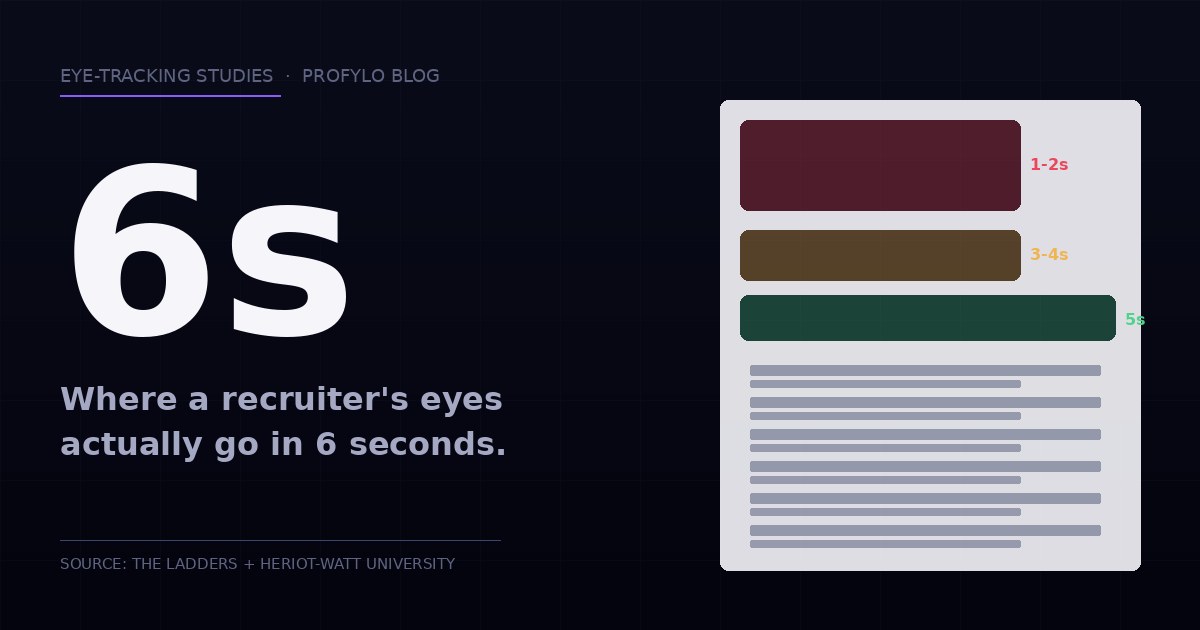
The 6-second test: where recruiter eyes actually go on your resume
Eye-tracking studies on real recruiters show 80% of their 6-second scan happens in four specific zones. Here's what they look at, and how to design a resume that survives the scan.
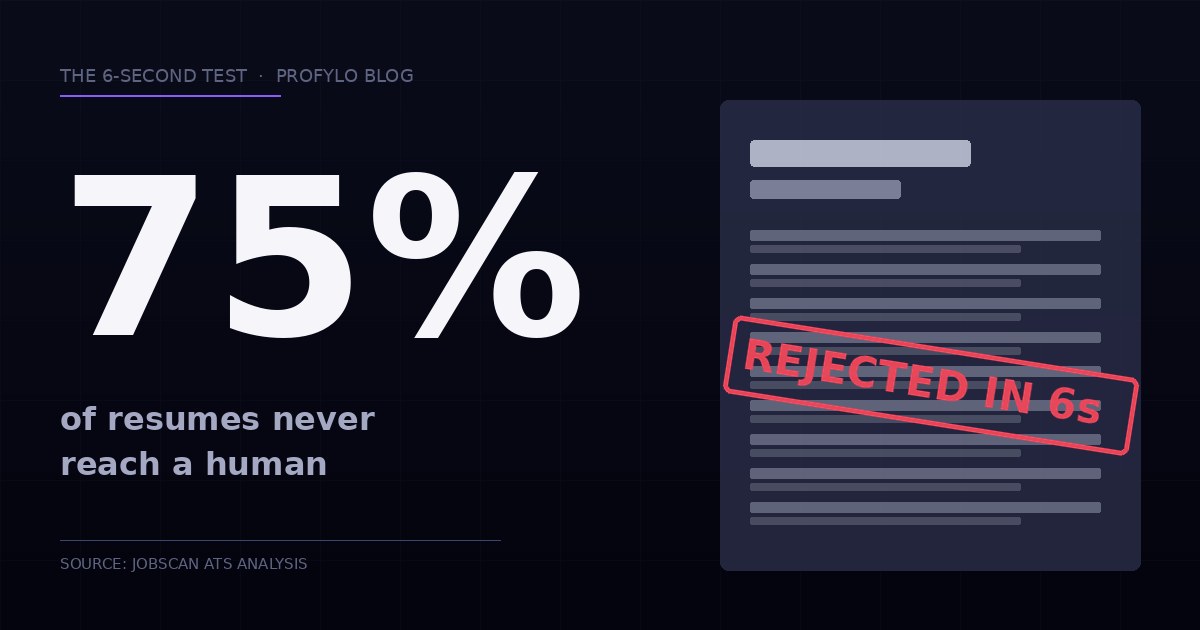
Why 75% of resumes never reach a human (and what to do about it)
Most resumes are rejected by ATS software before a recruiter ever sees them. Here's exactly why — and the 7 fixes that get you past the filter.
Welcome to the Profylo Blog
Career insights, ATS deep-dives, LinkedIn strategy, and India job-market analysis from the team building Profylo.